How AI Is Cutting M&A Due Diligence from Weeks to Hours - What Legal Professionals Need to Know in 2026
Due diligence has always been the part of the deal where time disappears.

Not because lawyers are inefficient. Because the task itself is structurally demanding: a large-scale deal can require reviewing hundreds or thousands of documents under compressed timelines, across overlapping workstreams, with the full weight of professional and ethical responsibility attached to every finding. The reading bottleneck, as practitioners who work in data rooms will recognise, is where most of the calendar quietly vanishes.
The numbers make this plain. According to Bayes Business School research cited by M&A transaction platform Peony, the average due diligence process now takes 203 days up 64% from a decade ago. A 2026 survey of 150 senior executives at US investment banks by SRS Acquiom and Mergermarket found that 73% of dealmakers expect the process to become even more complex over the next 12 to 24 months. Meanwhile, 41% of those same dealmakers identify completing due diligence as a top obstacle to closing.
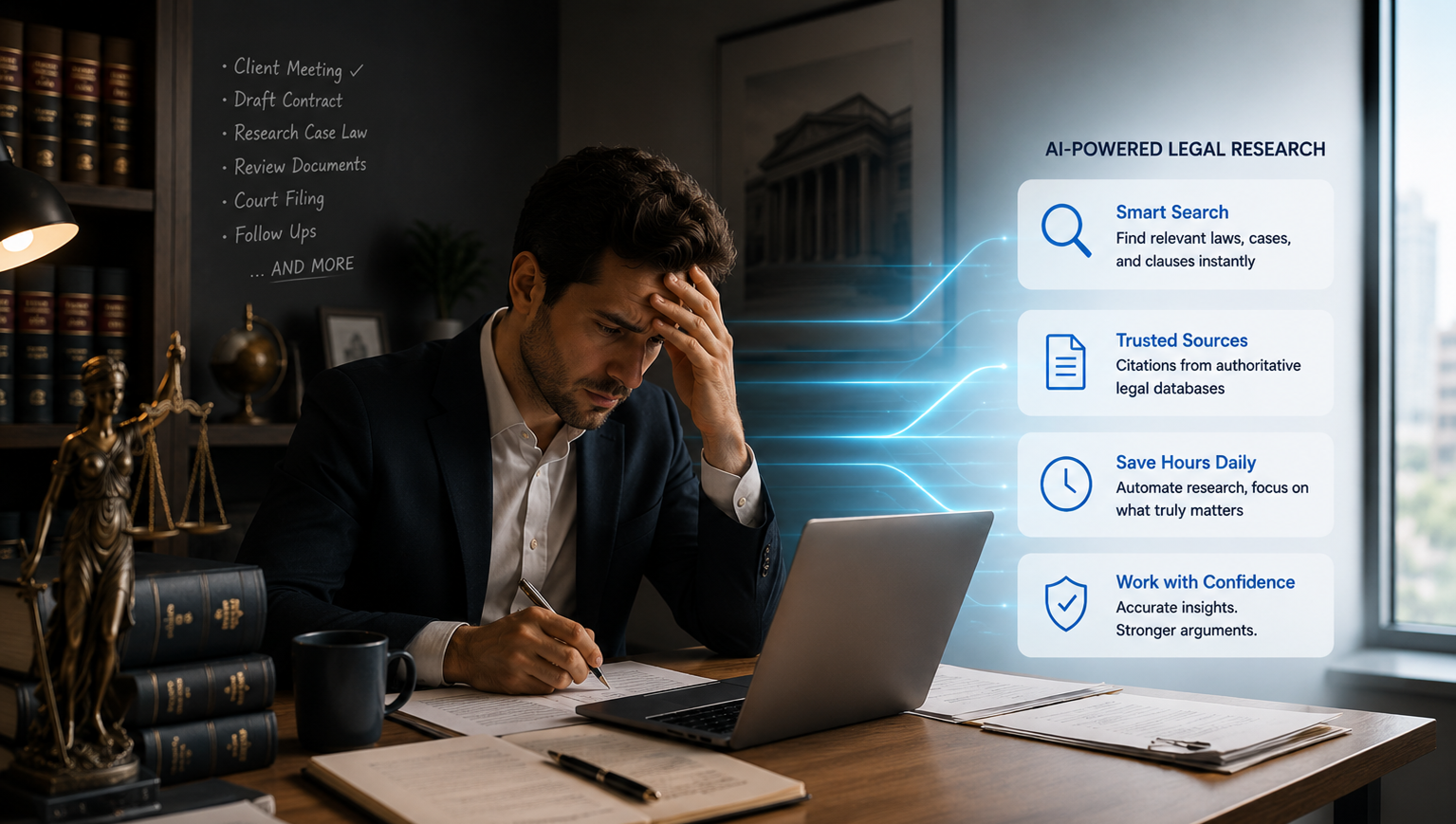
Something is shifting, however. Artificial intelligence when built for legal workflows rather than general-purpose use is beginning to compress these timelines in ways that are material, measurable, and worth understanding clearly.
The Anatomy of the Time Problem
Before examining what AI changes, it is worth being precise about where time actually goes in a due diligence exercise.
A standard middle-market deal, valued between $50 million and $500 million, typically runs six to twelve weeks from LOI signing to closing decision, with legal, financial, and commercial review proceeding in parallel. Complex cross-border transactions, deals requiring regulatory clearance, or those involving significant IP portfolios can extend to four to six months or more.
The timeline breaks down roughly as follows, per DealRoom's benchmark of 200-plus middle-market transactions:
Week 1: Data room launch and initial document requests
Weeks 2 to 3: First-pass legal, financial, commercial, and HR review
Week 4: Management interviews and site visits
Week 5: Synthesis, investment committee memo, cross-functional risk register
Week 6: Final negotiations, sign-off, and close
The critical variable inside that structure is not the quality of lawyers or the sophistication of advisors. It is document volume — and the human capacity available to process it. A CIM alone makes a hundred claims, each of which must be traced back to a financial statement, a contract, or a data-room file. When a small team does not have ten analysts, reading is the real bottleneck.
Legal due diligence specifically — covering contracts, employment, IP, litigation exposure, regulatory compliance, and corporate records — sits inside the period that most consistently overstays its welcome. 45% of respondents in the SRS Acquiom study identified technology review alone as the most expensive and onerous aspect of the process. And 31% of M&A failures trace directly to inadequate due diligence — not to the deal structure, not to integration, but to what was missed before signing.
This is precisely where the nature of the work — high-volume, pattern-intensive, deadline-compressed — makes it a candidate for augmentation by well-designed AI systems.
What AI Is Actually Doing in Due Diligence Today
It is important to be precise about the role of AI in this context, because imprecision creates professional and reputational risk for the lawyers who rely on it.
AI legal tools, when purpose-built for transactional work, are capable of the following in a diligence context:
Document triage and classification. AI can read and sort an entire data room — categorising documents by type, relevance, and workstream — in a fraction of the time required for manual organisation. What might take a paralegal team several days can be compressed into hours.
Clause extraction and flagging. Trained models can identify and extract specific provisions across hundreds of contracts simultaneously: change-of-control triggers, assignment restrictions, termination rights, indemnity positions, and exclusivity clauses. More importantly, they can surface non-standard or potentially material deviations from market norms. About 56% of lawyers say due diligence is the M&A stage where they are most likely to use AI, precisely because this extraction work is where the volume-to-judgment ratio is most unfavourable for humans working manually.
Cross-referencing and consistency checks. A representation made in the data room can be compared against corresponding contractual language, financial statements, or regulatory filings to identify inconsistencies that might not surface in a linear review.
Structured reporting. Rather than producing raw output, well-designed AI tools can generate issue lists, risk summaries, and diligence memos structured around the workstreams lawyers actually use.
The aggregate effect on timelines is documented. AI-assisted teams reduce diligence time by 60 to 80% on summarisation and first-pass review tasks compressing what previously took a week of data summarisation to approximately one day, per analysis by Bain & Company and V7 Labs. AI contract review reduces review time by up to 85% and achieves approximately 95% accuracy compared to roughly 80% for manual review, per legal industry statistics aggregated from Ironclad and LexCheck benchmarks. One legal AI platform, LEGALFLY, reports that contract review time among its in-house users drops from two hours to fifteen minutes — an 87.5% reduction for equivalent document volumes.
Herbert Smith Freehills used an AI contract review platform to review hundreds of leases in a single deal, with all outputs reviewed by lawyers for quality. The architecture in that workflow AI for volume, lawyers for judgment reflects the approach that deal teams who are getting consistent results appear to share.
The Limits That Senior Lawyers Must Understand
An honest assessment of AI in due diligence requires equal attention to what these tools do not do and cannot be asked to do.
AI does not replace legal judgment. The extraction of a clause is not the same as the analysis of its implications in context. A change-of-control provision in a licence agreement may be standard language in one jurisdiction, a closing risk in another, and a price adjustment lever in a third, depending on the deal structure and the governing law. That analysis remains the work of a qualified lawyer.
Hallucination risk is real and professionally significant. The Supreme Court of India's ruling in Pooja Ramesh Singh v. Jammu and Kashmir Bank Ltd. in June 2026, setting aside NCLT and NCLAT orders on the basis that tribunals had relied on non-existent, fake, hallucinated precedents allegedly generated through AI, is a clear signal that professional responsibility for AI output rests with the lawyer who relies on it. The ABA's Formal Opinion 512, issued in July 2024, requires lawyers using AI to discharge their obligations of competence, confidentiality, and supervision. These obligations do not diminish because a tool produced the first draft.
Data security is not a secondary concern. Due diligence data rooms contain some of the most commercially sensitive material in a client relationship. The appropriate question before deploying any AI tool in this context is not only what the tool can do, but how it handles the data — whether there is zero data retention, what encryption standards apply, and whether the tool's security posture is compatible with professional confidentiality obligations.
Jurisdiction matters. AI tools must adapt to local standards to avoid false alarms on clauses that are standard in one region but carry risk in another. A tool calibrated for US deal practice will not apply the same analysis to an Indian company law structure, an English law share purchase agreement, or a Canadian securities compliance review without meaningful adaptation. This is a structural limitation that varies by platform.
What a Purpose-Built Legal AI Workspace Looks Like for Diligence
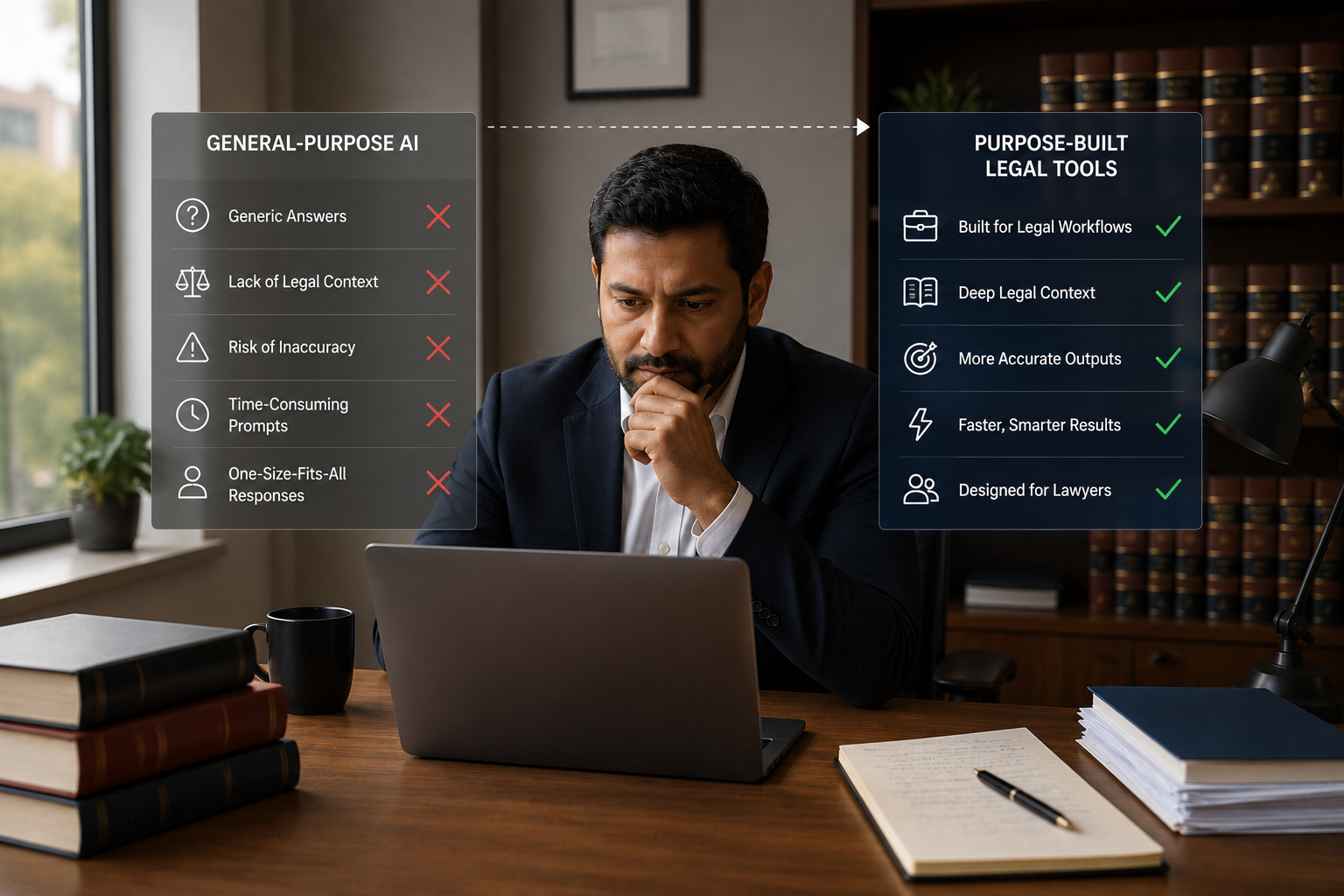
The distinction between general-purpose AI and a purpose-built legal research and drafting tool becomes particularly sharp in a due diligence context.
General-purpose models — including widely used consumer AI tools — can read documents and summarise content. What they do not provide is inline source citation, jurisdiction-aware analysis, professional-grade confidentiality controls, or the structured output formats that translate into actionable diligence memos. The risk of relying on a general-purpose tool for high-stakes transactional work is not theoretical; it is documented in court records across multiple jurisdictions.
A purpose-built legal workspace, by contrast, is designed around how lawyers actually work: ingesting documents, tracking sources to their origins, producing structured analysis by workstream, and supporting the drafting of findings in formats that integrate into the deal process.
Ovviously is built for precisely this kind of work. Designed for legal professionals across India, the UK, the US, Canada, and Australia, Ovviously functions as a legal research and drafting workspace — allowing lawyers to upload documents, interrogate them using jurisdiction-aware AI, and produce sourced, structured output that can be reviewed, edited, and issued as work product. The platform's inline citation architecture ensures that every AI-generated finding traces to a source the lawyer can verify, which is the foundational requirement for any output that will be relied upon in a transaction.
For transactional lawyers managing multi-document review, jurisdiction-crossing structures, or tight timelines with lean teams, Ovviously offers a research and drafting layer that compresses the mechanical burden of first-pass review without removing the lawyer from the centre of the analysis.
The Practice Question: Where Does AI Fit in Your Diligence Workflow?
The most useful framing for practitioners considering AI in due diligence is not "does this replace something?" but "where in my current process is document volume the constraint, and what happens when that constraint is removed?"
For most deal teams, the answer points to the same stages: initial document triage, first-pass clause review, cross-workstream consistency checking, and the drafting of findings into structured memos. These are the stages where AI demonstrates the most consistent time compression. They are also the stages that precede — and create the conditions for — the strategic legal judgment that remains irreducibly human.
Bain & Company's Global Private Equity Report projects that AI adoption in diligence will rise from 16% of deal teams in 2023 to 80% by 2028. In-house AI adoption for legal functions has already crossed 87% in 2026, per FTI Consulting and Relativity's General Counsel Report. The practice question for senior lawyers is therefore not whether this technology becomes standard, but whether the tools their teams adopt are built to the standard the work requires.
A checklist worth applying to any tool under consideration:
Does it provide inline, verifiable citations for every output?
Is its security posture — data retention, encryption, access controls — compatible with client confidentiality obligations?
Is it calibrated for the jurisdictions in which you practise?
Does it support structured output in formats your diligence process actually uses?
Does it keep the lawyer in control of every material finding and drafting decision?
These are not product-selection questions in the narrow sense. They are professional competence questions. The obligation to understand the tools one uses in client work is not new; it has simply become more consequential as the tools become more capable.
In Summary
M&A due diligence is one of the most demanding legal workflows by volume, timeline, and professional consequence. The 203-day average, the 64% increase in timeline over a decade, and the 41% of dealmakers who cite due diligence as a top obstacle to closing are not abstract statistics. They describe the experience of most deal teams working today.
AI, applied with precision and professional rigour, is demonstrably compressing the mechanical phases of this work — document triage, clause extraction, first-pass review — by margins of 60 to 85% in documented deployments. What it does not do is exercise judgment, bear professional responsibility, or substitute for the lawyer who understands what a finding means for the deal.
The appropriate use of AI in due diligence is therefore neither wholesale adoption nor reflexive avoidance. It is the deliberate identification of where document volume is the constraint, the application of tools that are built for legal work and not merely legal-adjacent, and the maintenance of the professional oversight that has always distinguished competent legal practice from its opposite.
For legal professionals looking to compress diligence timelines without compromising that standard, Ovviously offers a jurisdiction-aware legal research and drafting workspace purpose-built for exactly this kind of work.
Frequently Asked Questions
What is AI due diligence in M&A? AI due diligence in M&A refers to the use of artificial intelligence tools to accelerate and structure the document review process in a transaction. This includes automatic classification of data room documents, extraction of key contractual provisions, flagging of non-standard or risk-bearing clauses, cross-referencing of representations against supporting materials, and drafting of structured findings. The lawyer remains responsible for all material analysis and conclusions.
How long does M&A due diligence typically take in 2026? For middle-market deals valued between $50 million and $500 million, due diligence typically takes six to twelve weeks from LOI signing. The overall average across deal sizes, as measured by Bayes Business School research, now stands at 203 days — up 64% from a decade ago. Cross-border deals and transactions requiring regulatory clearance can take significantly longer.
Can AI replace lawyers in due diligence? No. AI compresses the mechanical phases of diligence — document triage, clause extraction, first-pass review, consistency checking — but the legal analysis of findings, the judgment applied to risk assessment, the strategic advice given to clients, and the professional responsibility for work product remain with the lawyer throughout.
What should lawyers verify before using an AI tool in due diligence? Lawyers should confirm that any AI tool used in due diligence provides verifiable inline citations for all output; operates under a security model (zero data retention, appropriate encryption) compatible with client confidentiality obligations; is calibrated for the relevant jurisdiction; and keeps the lawyer in control of all material findings and drafting decisions. The ABA's Formal Opinion 512 (2024) provides useful guidance on the professional competence obligations that apply.
What is the risk of AI hallucination in legal due diligence? AI hallucination — the generation of confident but factually incorrect content, including citations to cases or statutes that do not exist — is a documented and professionally significant risk. The Supreme Court of India set aside tribunal orders in June 2026 on the basis of reliance on hallucinated AI-generated precedents. Purpose-built legal AI tools with inline citation architecture mitigate this risk by tracing every output to a verifiable source; general-purpose consumer AI tools do not.
Which AI tools are purpose-built for legal due diligence? Several tools are designed specifically for legal workflows. Platforms such as Ovviously, which provides a jurisdiction-aware legal research and drafting workspace for lawyers across India, the UK, the US, Canada, and Australia, are built to meet the citation, confidentiality, and workflow standards that due diligence demands.
This article is intended for informational purposes and does not constitute legal advice. Lawyers should apply their professional judgment to any tools or approaches discussed, having regard to the applicable professional standards in their jurisdiction.