The Solo Lawyer's Time Problem And How AI Is Finally Solving It
Every hour you spend on research and drafting is an hour you are not billing. Here is what is changing that.
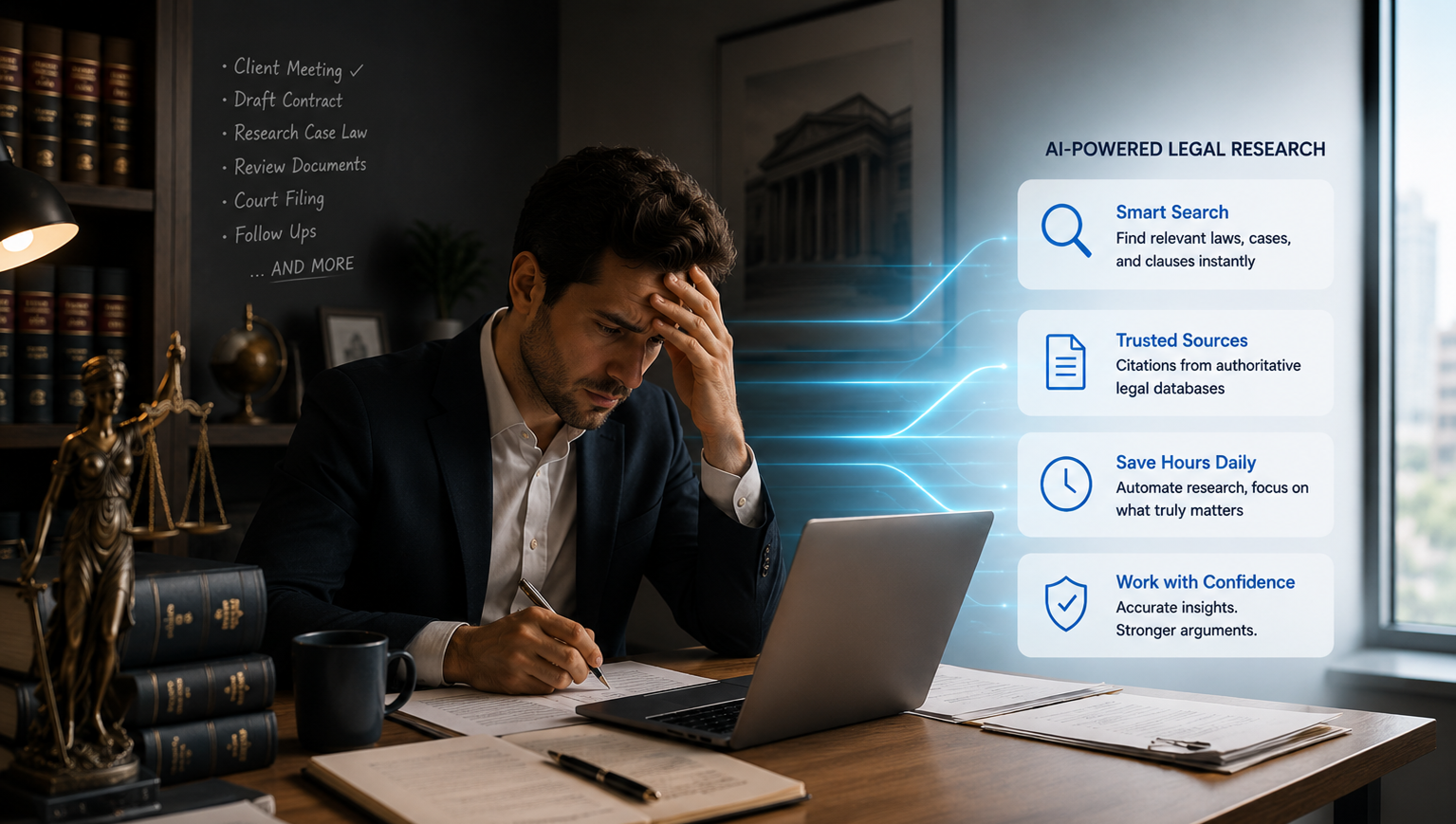
There is a structural reality that every solo practitioner carries into their working day, regardless of practice area, jurisdiction, or years of experience. Every decision, every task, every administrative obligation falls on one person. There is no paralegal to delegate research to. There is no junior associate to hand a first draft. There is no support staff to manage correspondence while the substantive legal work gets done. The same hands that appear in court prepare the pleadings, conduct the research, draft the documents, handle the billing, manage the client relationship, and keep the practice running.
This is not a complaint. It is the defining operational reality of solo practice, and most practitioners who have chosen this path do so with full awareness of what it requires. The question is not whether the workload is heavy. The question is how the time available is being used, and whether the tools available today are capable of changing that equation in any meaningful way.
The data suggests that the answer is yes. But it also reveals that the efficiency gains are not automatic. They depend on using the right tools for the right tasks, and on understanding where the actual time goes.
Where the Time Actually Goes
According to Clio's 2024 Legal Trends Report, for every eight hours a lawyer works, only 2.9 hours are billable. The remainder, more than five hours every single working day, is absorbed by non-billable tasks: administrative coordination, client communication, billing and time tracking, and the research and drafting work that either cannot be charged or is charged at a rate that does not reflect the time invested.
For a solo practitioner, this ratio is felt more acutely than in any other practice structure. A lawyer at a larger firm can offset some of this overhead by delegating non-billable administrative work to support staff. A solo practitioner cannot. Every email, every intake form, every invoice, every research task, and every first draft of a document competes for the same finite pool of daily hours.
The biggest time drains for most attorneys are drafting, reviewing case files, managing client communications, and handling administrative follow-up. Legal research and document drafting, in particular, sit at the centre of what consumes professional time without always producing billable output at a rate proportional to the effort invested. A research task that takes four hours and produces a two-hour memo is not uncommon. A contract that takes three hours to draft from a blank page, where a strong first draft might have taken forty-five minutes, represents a significant daily efficiency gap when multiplied across a full caseload.
Research suggests that up to 74% of tasks traditionally billed hourly could be automated or materially accelerated with AI. That is not a figure that recommends replacing legal judgment. It is a figure that identifies the portion of daily legal work where the volume-to-judgment ratio is most unfavourable for a professional working without support.
The Adoption Picture for Solo Practitioners
Solo and small firm lawyers have not been slow to recognise the potential. According to Clio's 2026 Legal Trends for Solo and Small Law Firms Report, 71% of solo practitioners and 75% of small firms are now using AI in some capacity. That adoption rate has risen sharply from 19% just two years ago.
The more revealing figure, however, is what is happening to revenue. Only 32% of solo practitioners and 31% of small firms have seen revenue growth since adopting AI, compared to 39% of mid-market firms and 59% of enterprise firms. Adoption is high. The results are uneven.
The gap between adoption and revenue growth has a straightforward explanation. The 2026 report identifies what it calls the efficiency paradox: if a matter used to take five hours and AI brings it down to one, billing hourly means the practitioner has effectively handed the client an 80% discount. The time is saved. The revenue is not captured. The efficiency gain disappears into the structure of the billing model rather than returning to the practitioner as capacity for additional work.
This is an important distinction. The time problem for solo lawyers has two components: the volume of non-billable work that consumes the day, and the billing model through which efficiency gains either do or do not convert into revenue. AI addresses the first component directly. The second requires a deliberate practice management decision that AI alone cannot make.
This article focuses on the first component, because it is where purpose-built AI tools are producing the most consistent and documentable change in how solo practitioners experience their working day.
The Fragmentation Problem
Before examining what AI changes, it is worth understanding a structural feature of how solo practitioners currently work that amplifies the time problem considerably.
A Harvard Business Review study of workers across large organisations found that professionals toggled between applications approximately 1,200 times a day, spending nearly four hours a week, the equivalent of roughly five working weeks a year, simply reorienting themselves after each switch. For a solo lawyer managing research in one window, drafting in another, client communication in a third, and an AI tool in a fourth that has no context on the matter being worked on, this fragmentation is not an abstract statistic. It is the texture of the working day.
The 2026 Legal Trends Report found that 47% of solo practitioners and 48% of small firms use consumer-grade AI tools that operate outside the system holding their matter information. This means the AI must be rebriefed on each matter every time it is used. There is no continuity of context. The efficiency gain from AI-assisted drafting is partially offset by the time spent explaining the matter to a tool with no memory of it.
The consequence is that many solo lawyers are saving time within individual tasks while losing time between them. The week's productivity leak is often not the individual tasks themselves. It is the seams between them.
What Research and Drafting Actually Cost in Time
Legal research and document drafting are the two tasks where the time cost for solo practitioners is most significant and most consistently documented.
On research, the challenge is well understood. A solo practitioner working on a novel point of law, a cross-jurisdictional question, or an area where case law is developing rapidly must locate relevant authorities, assess their weight, identify any contradicting decisions, and synthesise a position that is defensible and current. Done manually, this can take hours. Done with a general-purpose AI tool that has no jurisdiction-specific calibration and no inline citation architecture, it can produce impressive-looking output that requires significant verification before it is professionally usable.
On drafting, the numbers are equally clear. A survey of lawyers across corporate law, family law, and estate planning found that document automation produced time savings of over 90% on drafting tasks. That figure relates specifically to template-based automation for high-volume standard documents. For bespoke drafting, which requires genuine legal judgment, the efficiency gain is smaller but still material. AI-powered legal research platforms have been documented to dramatically reduce research time for litigators, while document analysis tools are streamlining due diligence for transactional practices. Smaller firms in estate planning, family law, and immigration are using AI to accelerate drafting of standard forms and petitions, reducing turnaround times without affecting quality.
The top benefits that solo and small firm lawyers report from AI are saving time and increasing efficiency, cited by 61% and 63% respectively. Saving money and improving the quality of work follow. The headline benefit is time. The practitioner's experience of that benefit, however, depends on whether the time recovered from research and drafting is absorbed by fragmentation between tools or genuinely returned to the working day as productive capacity.
The Tool Selection Question
Only 9% of law firms have a written, enforced AI use policy, and 54% have provided no AI training and have no plans to do so. For solo practitioners, the absence of a formal policy is understandable, but the absence of considered tool selection is a professional risk as well as a practical one.
The choice between a general-purpose AI tool and a purpose-built legal research and drafting workspace is not a matter of preference. It is a matter of fit between the tool's design and the professional context in which it is being used.
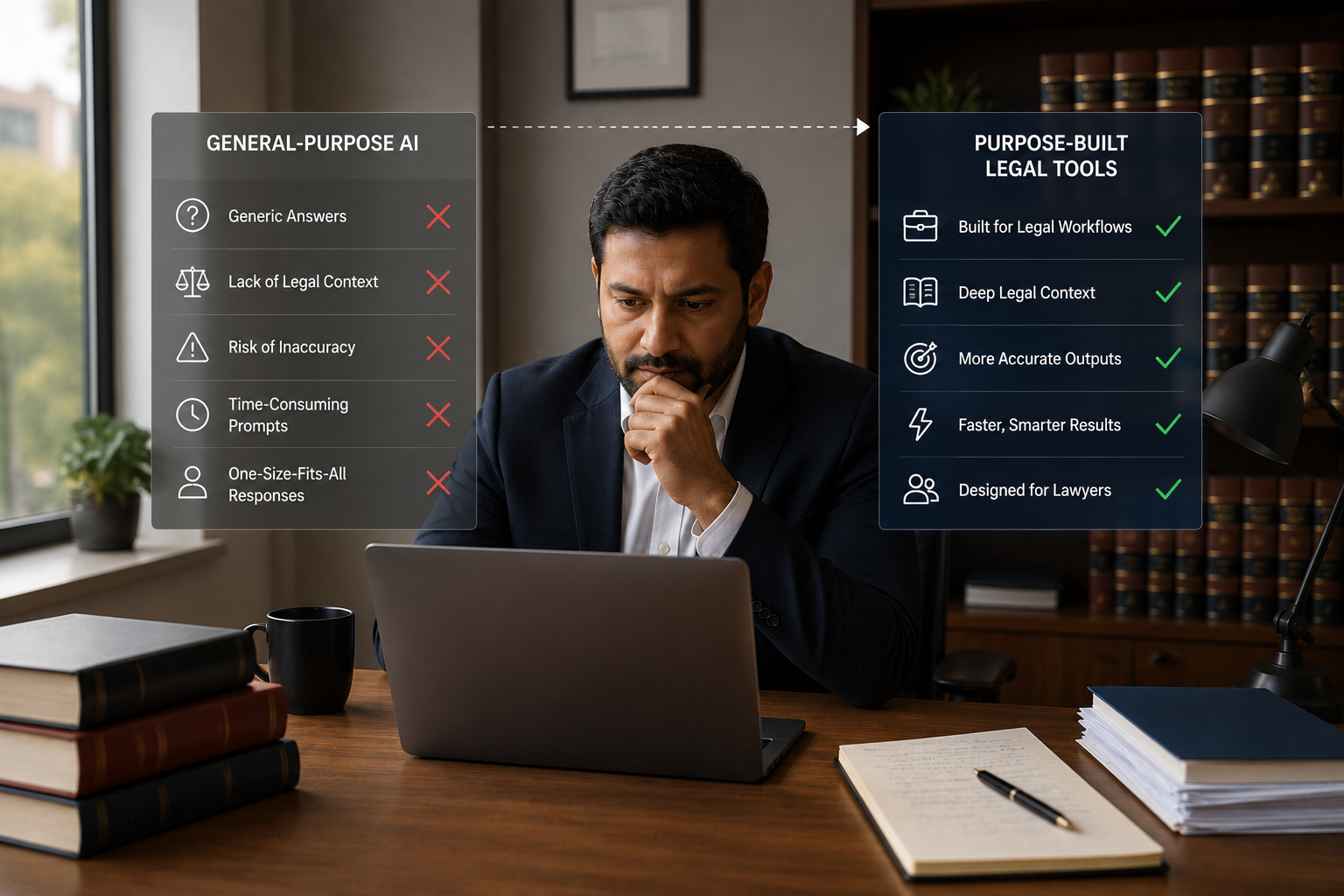
General-purpose AI tools built for broad consumer and business use are capable of producing fluent, structured text on legal topics. They were not designed with legal professional privilege in mind, with inline citation architecture that traces every finding to a verifiable primary source, or with jurisdiction-specific calibration. The top uses for general-purpose AI tools among legal professionals are drafting correspondence (58%), general research (58%), brainstorming (54%), and summarising documents (47%). These are precisely the tasks where the gap between general-purpose output and professionally usable output is most significant.
A solo practitioner using a general-purpose tool for legal research receives output that requires manual verification of every citation before it can be relied upon. That verification step is not optional. Courts in multiple jurisdictions have now issued judgments addressing the professional consequences of submitting AI-generated content that was not independently verified against primary sources. The time cost of verification, if done properly, reduces the net efficiency gain of the research task considerably.
A purpose-built legal workspace is designed around the verification requirement rather than leaving it as a manual step. Inline citations that trace every finding to a primary source mean the lawyer reviews a sourced output rather than an unsourced one. The verification step is embedded in the tool's architecture rather than being an additional task the practitioner must add to their workflow.
What Changes When the Right Tool Is in Place
The practical experience of solo practitioners who move from general-purpose tools to purpose-built legal research and drafting workspaces tends to follow a recognisable pattern.
The first change is in research. A jurisdiction-specific legal workspace produces sourced analysis of the applicable law on a given question, with citations the practitioner can verify directly against primary sources. The first-pass research output is not a finished product. It is a structured, sourced starting point that the lawyer reviews, exercises judgment on, and builds from. The time investment shifts from retrieval and organisation to analysis and judgment. That shift is the one that produces the most material difference in how a working day feels.
The second change is in drafting. A legal AI workspace that understands the relevant jurisdiction, the document type, and the matter context produces a first draft that is meaningfully closer to professional standard than a draft produced by a general-purpose tool that must be rebriefed on the matter. The gap between first draft and final work product narrows. The revision cycle shortens. The time per matter decreases without the quality of the output being compromised.
The third change is in continuity. A workspace that maintains matter context does not require the practitioner to rebrief the AI on each task. Research conducted on a matter is available when drafting begins. The fragmentation problem that consumes four hours a week in context-switching is partially addressed by the architecture of the tool itself.
The 2026 Legal Trends Report found that solo practitioners using AI in a structured, integrated way handle 37% more cases per lawyer than those using fragmented or no AI tools. That increase in capacity is the practical expression of what happens when time recovered from research and drafting is returned to the working day as productive capacity rather than disappearing into fragmentation or billing model gaps.
The Professional Obligation Dimension
It is important to note that the efficiency case for purpose-built legal AI tools is not the only relevant consideration. There is a professional obligation dimension that applies specifically to tool selection for legal work.
61% of those surveyed for the 2026 Legal Industry Report said AI saves them time every week. The same report found that data security (46%), ethical obligations (42%), privilege issues (39%), and doubts about the reliability of AI-generated outputs (39%) are the most commonly cited concerns among firm leaders considering AI adoption. These concerns are not irrational. They map onto the documented professional consequences that have followed from the unverified use of general-purpose AI tools in client work.
The professional obligation to verify AI-generated output, to maintain client confidentiality, and to ensure that work product submitted in any context is accurate and sourced does not diminish because a tool produced the first draft. It is the lawyer's obligation regardless of how the output was generated. Selecting a tool that supports that obligation through its architecture, rather than creating additional steps to meet it, is therefore both a practical and a professional consideration.
For solo practitioners in particular, where there is no supervision layer and no team to catch errors, the architecture of the tool matters more, not less.
Where Ovviously Fits
Ovviously is a legal research and drafting workspace built for legal professionals who do not have the luxury of a support team. It is designed around the tasks where solo practitioners consistently lose the most time: research that requires sourced, jurisdiction-aware output rather than fluent but unverified text, and drafting that requires a structured, professionally usable first draft rather than a starting point that needs significant reformatting.
The platform's inline citation architecture means that every research output traces each finding to a verifiable primary source. The jurisdiction-aware analysis means that the output reflects the legal environment in which the practitioner is working, not a generalised approximation of it. The drafting tools are designed to produce work product that is close to professional standard on first pass, narrowing the revision cycle that consumes a disproportionate share of drafting time.
For a solo practitioner whose working day is structured around being the only person responsible for everything, Ovviously is designed to function as the research and drafting layer that supports the substantive legal judgment that cannot be delegated, without adding the fragmentation overhead that general-purpose tools tend to create.
The Practice Decision
The data on solo practitioner AI adoption in 2026 tells a clear story. Adoption is high. The efficiency gains are real. The conversion of those gains into productive capacity, however, depends on the tool being used, the tasks it is applied to, and whether its architecture is compatible with the professional context of legal work.
Only 8% of solo practitioners have adopted AI widely or universally, despite 71% using it in some capacity. The gap between experimentation and systematic adoption is where most of the unrealised efficiency sits. Firms that have closed that gap by adopting AI in a structured, deliberate way are handling more cases per lawyer, delivering faster turnaround, and competing with larger practices on quality and speed in a way that was not operationally possible without the technology.
Solo practices account for around 40% of all law firms, and firms with fewer than 6 attorneys account for more than 75% of the total. The structural case for AI adoption at this scale of practice is stronger than at any other. The decision about which tools to adopt, and for which tasks, is the one that determines whether that case is realised in practice.
Frequently Asked Questions
How much time do solo lawyers spend on non-billable work? According to Clio's 2024 Legal Trends Report, for every eight hours a lawyer works, only 2.9 are billable. This means more than five hours of every working day is absorbed by non-billable tasks including research, drafting, administrative coordination, billing, and client communication. For solo practitioners, this ratio is felt more directly than in any practice structure with support staff.
What tasks benefit most from AI for solo lawyers? Legal research and document drafting are the tasks where AI produces the most consistent and documentable time savings for solo practitioners. Research that involves locating, organising, and synthesising case law benefits from AI that produces sourced, jurisdiction-aware output. Drafting benefits from AI that produces a structured first draft close to professional standard, narrowing the revision cycle. Administrative tasks such as correspondence and document summarisation are also commonly cited benefits.
What is the difference between general-purpose AI and a purpose-built legal AI workspace? General-purpose AI tools are designed for broad consumer and business use. They produce fluent, structured text but were not designed with legal professional privilege, inline citation architecture, or jurisdiction-specific calibration in mind. A purpose-built legal workspace is designed around the requirements of professional legal work: sourced outputs that trace every finding to a verifiable primary source, jurisdiction-aware analysis, and confidentiality architecture appropriate for client matter work. The practical difference is that a purpose-built tool supports the professional obligations that apply to legal work through its architecture, rather than requiring the practitioner to add verification steps as a separate task.
Why are solo practitioners not seeing revenue growth despite using AI? The 2026 Legal Trends for Solo and Small Law Firms Report identifies what it describes as the efficiency paradox: when billing by the hour, time saved by AI effectively reduces the invoice to the client rather than returning to the practitioner as revenue. The efficiency gain is real; the revenue conversion requires a deliberate billing model decision, typically a move toward flat fees or value-based billing, that captures the value of faster delivery rather than pricing it away. AI addresses the time problem. The billing model decision determines whether that time converts to revenue.
What should a solo lawyer look for when selecting an AI tool for legal work? The core requirements are: inline citations that trace every output to a verifiable primary source; jurisdiction-aware analysis calibrated to the legal systems in which the practitioner works; a confidentiality and data security architecture appropriate for client matter work; structured output that is close to professional standard on first pass; and a workspace design that reduces fragmentation between research, drafting, and matter management rather than adding another disconnected tool to the workflow.
This article is intended for informational purposes and does not constitute legal advice. Practitioners should apply their professional judgment to any tools or approaches discussed, having regard to the applicable professional and regulatory standards in their jurisdiction.