The Startup Legal Checklist VCs Are Using in 2026, What Founders Need Ready Before Lawyers Arrive
What investor-side counsel checks first — and what founders almost never have ready.

Nobody tells founders this at the beginning. You spend months refining the pitch, rehearsing the numbers, getting the deck to the right twelve slides. Then a serious investor says they're interested. A term sheet arrives. And suddenly the meeting rooms go quiet and a group of lawyers you've never spoken to start going through everything the company has ever done.
That review is legal due diligence. And one-third of funding deals collapse at this stage, not because the business failed, but because the documentation behind it couldn't hold up to scrutiny. Messy cap tables, IP that the company doesn't actually own, contractor arrangements that nobody properly formalized. These are the things that kill deals that should have closed.
For lawyers advising investors, this list is familiar territory. For lawyers advising founders, the value is in knowing what's coming before it arrives. This article sets out the legal checklist that investor-side counsel work from in 2026, and explains what founders need to have ready long before the data room request lands.
Why the Legal Review Happens
When It Does
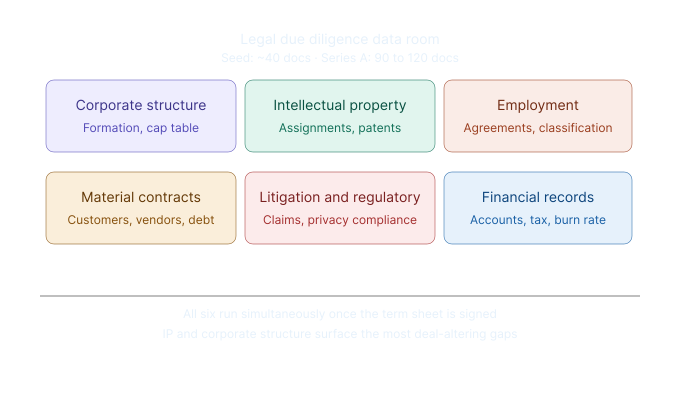
People assume legal due diligence runs alongside the commercial review. It usually doesn't. The legal review is typically the last stage of the investment process, triggered after commercial diligence is done and the investor has already committed to the deal in principle. By the time lawyers get involved, the investor likes the business. What the legal process determines is whether they can actually close the deal without acquiring problems they didn't bargain for.
That timing matters for founders. The exclusivity period in most term sheets runs between 45 and 60 days. A disorganized data room that founders scramble to fill after signing a term sheet can consume weeks of that window, and investors watching the clock start asking questions about competence that have nothing to do with the underlying business. The founders who close fastest are rarely those with the cleanest companies. They're the ones who prepared the data room before anyone asked for it.
Modern AI-assisted review tools have compressed document review timelines by 40 to 70 percent. That speed works against founders who aren't ready. What used to take two weeks can now take four days. Gaps surface faster. So does the investor's uncertainty about whether to proceed.
What Investor-Side Lawyers Actually Request
A standard legal due diligence request list covers corporate structure, intellectual property, employment, material contracts, litigation history, and regulatory compliance. The depth of each workstream scales with the round. A seed-stage review is relatively light. A Series A involves board minutes going back to incorporation, all signed equity documents, and every material commercial agreement the company has entered. Series B and beyond adds audited financials, tax compliance records, and a granular review of any government or regulatory interactions.
A Series A data room typically runs to 90 to 120 documents. Here is what sits inside each category.
Category One: Corporate Structure and Governance
This is where lawyers start, and it's where the most basic problems tend to appear.
Investors want to see the company's formation documents, its current bylaws or operating agreement, and a certificate of good standing dated within the last 30 days. They want complete board minutes going back to incorporation, every director resolution, every shareholder consent, every major decision documented in writing. Many early-stage companies have gaps here. A board meeting happened over a video call, no minutes were taken, and a resolution authorizing a material contract was never formally passed.
These gaps aren't usually fatal, but they raise a question lawyers are paid to ask: if the records don't reflect what actually happened, what else might be missing?
The cap table sits at the center of this workstream. Every equity interest, every option grant, every convertible note and SAFE must be reconciled against a signed physical document. For each name on the cap table, there needs to be a corresponding stock purchase agreement or subscription agreement. If a co-founder was promised two percent of the company in an early email but that agreement was never formalized, the investor needs to know before the deal closes, not after.
Lawyers also look for dead equity. A co-founder who left the company in the first year but holds a significant stake because no vesting schedule with a cliff existed at the time is a structural problem that requires resolution before most institutional investors will proceed.
Category Two: Intellectual Property
For any technology business, this is the workstream that carries the most risk. And it's the one founders most often get wrong.
The core question lawyers are asking is simple: does the company actually own the technology it's built and is selling? The answer is less obvious than it sounds.
Lawyers review whether every founder, employee, and contractor who contributed to the product has signed a written agreement assigning their intellectual property to the company. Without that agreement, the default position in most jurisdictions is that the creator owns what they built. A developer who wrote a core module as a freelancer, under a contract with no IP assignment clause, may legally own that module even if the company has been using it for three years and built an entire product around it.
Pre-incorporation IP is another gap that appears constantly. Founders who built the initial version of the product before formally incorporating need to have executed IP assignment agreements transferring that pre-incorporation work to the company. If they haven't, the company doesn't own its founding technology.
Open-source licensing is a third area that has sharpened in 2026. Investors are increasingly alert to copyleft licenses in a company's codebase that could require the company to release its own proprietary code publicly. Fenwick and West's 2025 Startup Survey found that open-source license conflicts delayed or blocked one in five Series A closings that year. That number is striking. It means a company can lose a funding round not because its product is bad but because of a licensing decision a developer made two years ago without flagging it to anyone.
Registered intellectual property, trademarks, patents, domain names, should be documented and confirmed to be owned by the company rather than by a founder personally.
Category Three: Employment and Contractor Arrangements
Worker classification is a category that trips up a high percentage of early-stage companies, and the cost of getting it wrong lands on the investor if it isn't caught during diligence.
Startups frequently keep their early payroll lean by engaging technical contributors as contractors rather than employees. This makes operational sense at the time. What it creates is potential liability if the classification doesn't hold up under the relevant jurisdiction's employment tests, which typically look at factors like exclusivity, control over how work is done, and whether the person has other clients.
Lawyers will review whether key engineers, designers, and early contributors were properly classified, and whether anyone with deep access to the company's systems or products is subject to non-compete or non-solicitation obligations from a prior employer that could create injunction risk. The second point is a real concern for technical hires who moved from one technology company to another without paying attention to what their previous employment agreement said.
Employment agreements for key executives, compensation plans, equity terms, confidentiality and IP assignment clauses, are all reviewed. A company that has key employees without signed agreements covering IP ownership is a company that doesn't fully control what its own team creates.
Category Four: Material Contracts
Investors need to understand what the company has committed to and what obligations it carries into the investment.
The top five to ten customer contracts are reviewed closely. Lawyers look specifically for change-of-control clauses that might allow a customer to exit the contract the moment an investment closes or a new shareholder comes in. If a major customer can walk away upon a change in ownership, the investment thesis changes materially. Investors who discover this mid-diligence tend to react badly, not because the clause is necessarily a dealbreaker, but because it wasn't disclosed upfront.
Vendor agreements, particularly cloud hosting contracts and data licensing arrangements, are also reviewed for term length, pricing commitments, and any exclusivity provisions that could limit the company's future flexibility. Convertible notes, SAFEs, and any existing credit facilities are all documented and confirmed to be reconciled with the cap table.
Key partnership agreements that exist only as verbal understandings or email chains are a consistent red flag. Investors want legally documented arrangements for anything material to the business. An undocumented partnership doesn't just create legal uncertainty; it suggests operational practices that don't match the presentation investors received during the commercial review.
Category Five: Litigation and Regulatory Exposure
This workstream is about understanding what claims currently exist, what claims might exist, and what regulatory environment the company is operating in now versus the one it will be operating in as it scales.
A complete litigation history is standard. Any past or pending lawsuits, demand letters, or regulatory notices need to be disclosed, and undisclosed disputes that surface during background checks destroy the trust built during commercial diligence more reliably than any single document.
Regulatory exposure is where the review has grown in 2026. Lawyers are now asking not just whether the company is currently compliant, but what the regulatory environment will look like in 18 months as the company scales into new markets or customer segments. A company in fintech, health technology, or AI-adjacent products faces meaningful regulatory scrutiny ahead that may require compliance infrastructure the company doesn't have today. The gap between current practice and future requirement is a real cost that belongs in the deal pricing.
Data privacy compliance has become a full workstream on its own. Lawyers review whether the company's privacy policy reflects its actual data practices, whether consent mechanisms meet applicable standards, and whether vendor agreements adequately address data handling. Companies that have grown fast without keeping up with privacy compliance are common, and the cost of remediation can be significant.
What Good Preparation Actually Looks Like
The founders who move through legal due diligence fastest share one characteristic: they found the problems before the lawyers did.
That means running an IP audit before fundraising begins. Confirming that every founder, contractor, and early contributor has signed an IP assignment agreement. Cleaning the cap table against physical stock records. Making sure board minutes exist for every material resolution. Reviewing the top customer contracts for change-of-control language before an investor asks to see them.
A well-organized data room built before the term sheet is signed can cut as much as a week off the closing process. That week matters in a 45-day exclusivity window. It also signals something to the investor about how the founders run the company. A disorganized data room assembled under deadline pressure communicates something different.
The founders who move through diligence smoothly are not those with zero problems. They are the ones who discovered their own problems early, stayed organized, and built a clear plan to address them. That distinction, between hidden problems and disclosed problems with a resolution plan, is often the difference between a deal that closes and one that quietly dies.
For lawyers advising founders ahead of a raise, the research burden across this preparation work is real. Confirming what the relevant jurisdiction requires for valid IP assignment, checking what employment classification tests apply in each market the company operates in, understanding what regulatory notices have to be disclosed in the relevant sector, none of that research happens quickly when done manually. Ovviously is built for exactly this kind of work: a legal research and drafting workspace for lawyers across multiple jurisdictions, with citations tied to primary sources and output structured around the practical questions that actually arise in a transaction. For lawyers helping founders get ready before the data room opens, Ovviously cuts the research overhead that otherwise consumes the early stages of preparation.
The Role of Representations and Warranties
Once legal diligence is complete, the findings feed directly into the definitive agreements, specifically, the representations and warranties that the company makes to the investor at closing.
Every gap identified during diligence either gets fixed before closing, gets disclosed in a schedule that carves it out of a representation, or becomes a negotiating point around indemnification. Gaps that are discovered late, after negotiations have advanced, tend to create more difficult conversations than gaps that were disclosed early and addressed transparently.
This is why preparation matters beyond just the logistics of getting documents into a folder. A founder who can say "we identified this issue six months ago and here is what we did about it" is in a fundamentally better position than one who learns about the same issue from an investor's lawyer. The facts may be identical. The dynamic is completely different.
Frequently Asked Questions
What does a startup data room need to contain for a Series A? A Series A data room typically covers six categories: corporate structure (formation documents, board minutes, cap table with supporting documentation), intellectual property (IP assignment agreements from all contributors, trademark and patent filings, open-source software inventory), employment (agreements for all key employees and contractors, classification analysis), material contracts (top customer agreements, vendor contracts, existing debt instruments), litigation and regulatory history (any past or pending claims, regulatory interactions, privacy compliance documentation), and financial records (audited statements, management accounts, tax filings). At Series A, the full data room typically runs to 90 to 120 documents.
What is the most common legal problem lawyers find in startup due diligence? Intellectual property ownership gaps are among the most consistently documented issues. Companies regularly present without having executed IP assignment agreements with early contractors or founders who built the initial product. In 2025, open-source license conflicts delayed or blocked one in five Series A closings. Cap table irregularities are a close second: undocumented informal equity commitments, option grants made without proper board approval, and SAFEs or convertible notes with conversion mechanics that don't match what the founders described in the pitch.
How long does legal due diligence take for a startup? Timeline depends heavily on how organized the company's documentation is before the process begins. A seed round with clean documentation takes roughly four to eight weeks after the term sheet. Series A runs six to twelve weeks. Series B and beyond can run twelve to sixteen weeks. A disorganized data room can add weeks to any of these timelines, which matters when the exclusivity window in the term sheet is typically 45 to 60 days.
What is a change-of-control clause and why do investors care about it? A change-of-control clause in a customer or commercial contract gives the other party the right to terminate or renegotiate the agreement if the company's ownership changes in a material way. When an institutional investor takes a meaningful equity stake, that event can trigger change-of-control clauses in major contracts. If a customer representing a large share of revenue can exit the contract the moment an investment closes, the economic basis of the deal changes materially. Lawyers review all major contracts for these provisions during diligence, and undisclosed change-of-control clauses that surface late in the process tend to damage trust more than the clause itself.
What should founders do before starting a fundraise to prepare for legal due diligence? The most practical steps are: run an IP audit to confirm every contributor has signed an assignment agreement; reconcile the cap table against physical stock records and identify any informal commitments that need formalizing; confirm board minutes exist for all material decisions; review major customer contracts for change-of-control language; and assess whether worker classification is defensible in the jurisdictions where the company operates. Founders who identify and address these issues six to twelve months before fundraising are in a materially better position than those who discover the same issues under deadline pressure once a term sheet is signed.
What is the difference between legal due diligence for a seed round versus a Series A? A seed round legal review is typically lighter, focused on the core formation documents, basic IP assignment, and any material contracts already in place. At Series A, the process expands considerably: board minutes going back to incorporation, all equity documents reconciled to the cap table, employment agreements for every key hire, a deeper IP review including open-source compliance, and a full review of customer and vendor contracts. The difference isn't just depth, it's also in how investor-side lawyers approach the exercise. Series A counsel is usually more experienced in spotting structural problems that would be harder to fix once institutional capital is in.
This article is for informational purposes only and does not constitute legal advice. Legal professionals and founders should obtain qualified legal counsel for their specific circumstances, having regard to the applicable law and professional standards in their jurisdiction.